Four positions on one knob
What 101 Distill's RATIO asks of the model at 2:1, 4:1, 8:1 and ∞:1, and when to reach for each.
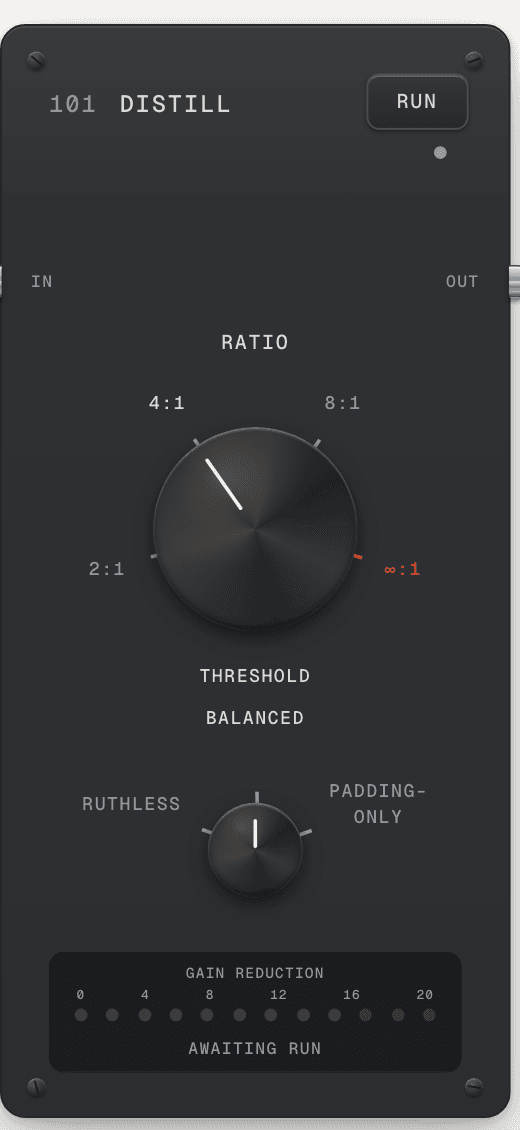
101 Distill does one thing: it compresses writing down to what the writing can't do without. Its main control is RATIO, a knob with four detents. Each detent sends its own written instruction to the model, so the knob's position is the instruction.
Documented mapping
Bar lengths are approximate: each position asks for a length, not a word count.
4:1 Roughly a quarter. The essence plus only the connective tissue it needs to stand.
The four positions
- 2:1 asks for roughly half the length. The fat goes; the argument keeps its full shape. Reach for it when a draft is right but long.
- 4:1 asks for roughly a quarter: the essence, plus only the connective tissue it needs to stand. Good for a brief someone will read once.
- 8:1 asks for two or three short sentences. Only the load-bearing claims survive. This is the status line, the note at the top of a long thread.
- ∞:1 is the limiter: one sentence, the single claim the material can't stand without. It is also a test. If that sentence isn't the point you meant to make, the material is telling you something.
Beside the ratio
THRESHOLD, the second knob, sets cut order. RATIO owns the length; THRESHOLD decides what fills it. At RUTHLESS the budget goes to bare claims. At PADDING-ONLY it goes to the stories, names and numbers, and the general claims give way first. BALANCED sits between. The meter at the bottom shows gain reduction after a run: how much came out. Before the first run it says so, and shows nothing else.
The more you use an instrument, the more you learn what it can do. Distill teaches one thing quickly: most writing has a sentence in it that carries the rest, and turning the knob is a fast way to find out which one.